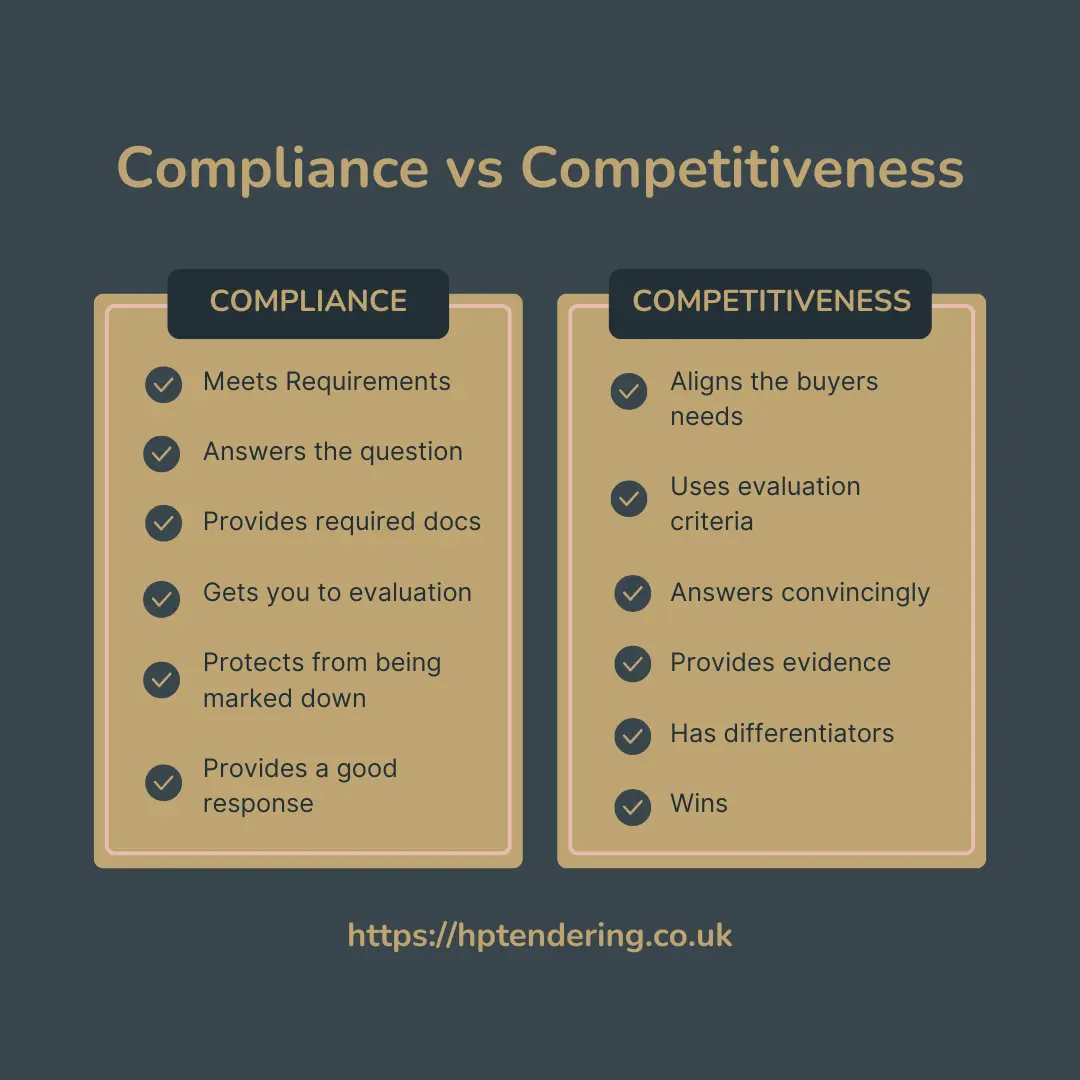
One of the biggest misconceptions in tendering is that a compliant bid is automatically a competitive bid. It isn’t.
Compliance is essential. If a buyer asks for specific documents, sets a word count, requires responses in a particular format or includes mandatory requirements, those instructions need to be followed. Getting them wrong can result in a submission being marked down or, in some cases, excluded from the procurement altogether.
But meeting the requirements only gets your tender to the point where it can be evaluated. It doesn’t necessarily give the evaluator a reason to choose you.
That is where competitiveness comes in.

What Makes a Tender Compliant?
At its simplest, compliance means giving the buyer what they have asked for, in the way they have asked for it.
That includes answering every question, providing the required documents and evidence, meeting mandatory criteria and following the submission instructions. It also means paying attention to details such as page limits, word counts, file formats, naming conventions and deadlines.
These things can sound administrative, but they matter. A fantastic response to the wrong question is still the wrong response, and a missing mandatory document can undermine an otherwise strong submission.
Compliance therefore provides the foundation of a good tender response. The problem comes when businesses stop there.
A Correct Answer Isn’t Necessarily a High-Scoring Answer
Imagine a buyer asks how you will manage service quality throughout the contract.
A compliant response might describe your quality management process, explain who is responsible and confirm that performance will be monitored. Technically, the question has been answered.
A more competitive response goes further. It considers what the buyer is actually trying to establish through the question. What risks are they concerned about? What outcomes are they trying to achieve? What evidence can you provide that demonstrates your approach works?
Instead of simply describing a process, the response can demonstrate how that process will operate on this particular contract, who will be accountable, how performance will be measured, what happens when something goes wrong and, importantly, what benefit that approach provides to the customer.
Both responses may be compliant, they are unlikely to receive the same score.
Write for the Evaluation Criteria
Tender responses aren’t evaluated on whether they sound impressive. They are evaluated against the criteria and scoring methodology set by the buyer. Understanding those criteria should influence how a response is developed.
If the evaluator needs detailed evidence to award the highest score, making unsupported statements about experience or capability isn’t enough. If the scoring guidance asks for comprehensive methodology, a high-level description may satisfy the question but still limit the score available.
Competitive tender writing therefore means thinking about the evaluation while developing the response rather than simply checking it afterwards. What does the evaluator need to see to confidently award a high score? That question should sit behind every response.
Evidence Makes Claims Credible
Most businesses can say they provide excellent service, employ experienced people or have effective processes. Your competitors can say exactly the same thing. Evidence is what makes those statements meaningful.
That might include performance data, customer outcomes, contract examples, case studies, accreditations, lessons learned or measurable improvements achieved elsewhere.
The strongest evidence doesn’t simply prove that something happened. It helps the evaluator understand why it matters to their contract.
For example, demonstrating that a new process reduced response times on another contract is useful. Explaining how the same approach will be applied to the buyer’s service and what improvement they can expect makes that evidence considerably more relevant.
Competitive Responses Focus on the Buyer
One of the easiest traps in tender writing is spending too much time talking about your own business. Your history, experience, systems and people all matter, but the buyer is ultimately evaluating what those things mean for them.
A competitive response connects your capability to their requirements, priorities and desired outcomes instead of simply saying what you do, it explains how you will do it, why your approach is appropriate, what evidence supports it and what the customer gains from it.
That shift can make a significant difference to how a response reads from an evaluator’s perspective.
Differentiation Doesn’t Mean Inventing a Gimmick
Businesses are often told that bids need clear differentiators, which can lead to a frantic search for something completely unique, it doesn’t necessarily need to be unique.
A differentiator can be a particular approach, capability, resource, process or piece of evidence that gives the buyer greater confidence or delivers additional value compared with alternative solutions. The important part is making that difference relevant.
Something isn’t valuable simply because your competitors don’t offer it. It becomes valuable when it helps solve a problem, reduce a risk or improve an outcome that matters to the buyer.
Could Your Tender Be Stronger?
HP Tendering Consultancy supports businesses at different stages of the tendering process, from developing and managing complete submissions to reviewing existing responses before they are submitted.
An independent bid review can help identify where a response technically answers the question but could do more to demonstrate evidence, strengthen customer benefits or align with the evaluation criteria.
If you have a tender in progress and want an experienced second pair of eyes before submission, get in touch to discuss bid review support.